

The Smart Way to Organize Hunting Documents in the Field
There's a moment every experienced hunter dreads.
You've just harvested an animal after four days of hard hunting in rugged country. A game warden walks up the trail. They ask for your license. Your tag. Your habitat stamp.
And you can't find any of it.
Your license is in your truck, eight miles away. Your tag is somewhere in your pack, maybe in the top pocket, maybe stuffed in with your first-aid kit. The habitat stamp? You're pretty sure you downloaded it to your phone, but your battery died two days ago.
This exact scenario is one we often hear about at Hunt-Tag. We find that it’s not because hunters ignore the rules, but because multi-day hunt paperwork has become complicated.
Most hunters take gear seriously, but when it comes to organizing hunting documents, they treat them as an afterthought.
That's a mistake with real consequences.
How to Organize Hunting Documents for Multi-Day Trips
A simple system makes a big difference on extended hunts. It doesn’t need to be complicated, but it does need to be deliberate. The goal is to remove guesswork and avoid problems when conditions get rough or when rules are checked in the field.
Start With a Complete Inventory
Before any multi-day trip, list every document you are legally required to carry. That starts with reading the current regulations for each state and unit being hunted.
Rules change from year to year, and relying on last season's knowledge can lead to mistakes.
For each document, note:
-
Whether the original, a copy, or a digital proof is required
-
Whether it must stay on your person or can remain at camp or in a vehicle
-
Whether it’s single-use, like a tag, or continuous, like a license
Separate Daily-Carry from Base Camp Documents
Not everything needs to be on your body while hunting. Some documents can stay at your vehicle or base camp. Others must be with you every moment you're in the field.
On your person at all times:
-
Hunting license (physical or digital backup)
-
Unfilled tags for any species you might encounter
-
Unit-specific permits or authorizations
-
Federal stamps if hunting migratory birds
At base camp/vehicle:
-
Original copies of documents (if carrying copies in the field)
-
Extra printed backups
-
Charging equipment for phones
-
Vehicle registration and insurance (in case you need to transport game on roads)
This separation reduces what you carry while ensuring critical documents are always accessible.
Protect Against Water and Damage
Paper documents degrade quickly when exposed to moisture unless protected. Using two layers of protection helps prevent damage in the field.
First, laminate documents or place them in heavy-duty waterproof sleeves if they need to be carried while hunting. This adds minimal weight, but that weight helps protect compliance.
Second, store those protected documents in a waterproof container or pouch that stays in a consistent location in your pack or vest. Knowing exactly where documents are stored saves time and reduces stress when they need to be shown.
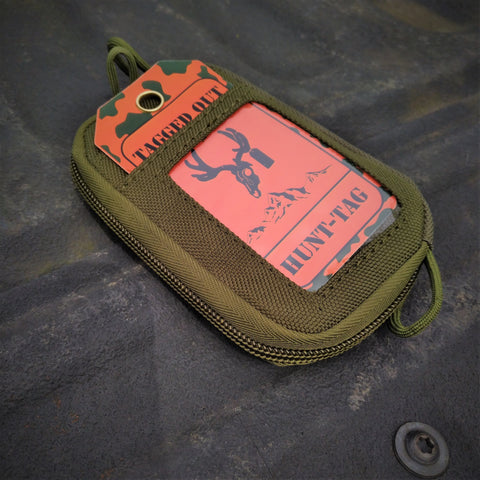
The Hunt-Tag Wallet is designed specifically for this purpose, keeping hunting documents organized, protected, and immediately accessible.
The key is consistency. Your documents should always be in the same place. When a warden asks for your license, your hand should move automatically to the right pocket.
Build Phone Redundancy Into Your System
Many hunters rely on their phones for digital licenses and e-tagging. This works fine for day hunts near the truck. For multi-day trips, it's risky.
Phone batteries die. Screens crack. Cold weather drains power rapidly. If your only proof of licensure is on a dead phone, you have a problem.
Here’s the smart approach:
-
Keep a physical backup of every digital document
-
Carry a small portable battery pack. The Tech Pouch is designed to protect electronics in field conditions
-
Screenshot digital licenses so they're accessible offline
-
Enable airplane mode to preserve battery when not actively using the phone
Organize Tags for Immediate Access
Tags deserve special attention because they're time-sensitive. In many states, you must physically attach a tag to an animal immediately upon harvest, before moving the carcass, or before field dressing begins. "Immediately" means immediately.
This requirement creates a specific organizational challenge: your unfilled tags need to be accessible at the moment of harvest, in conditions that don't favor fumbling through paperwork.
For states still using paper tags, keep unfilled tags in a dedicated sleeve, separate from your license and other documents, positioned where you can grab them one-handed.
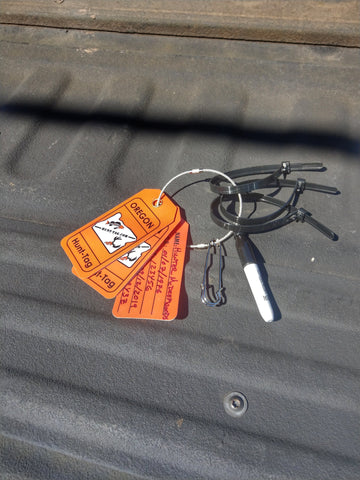
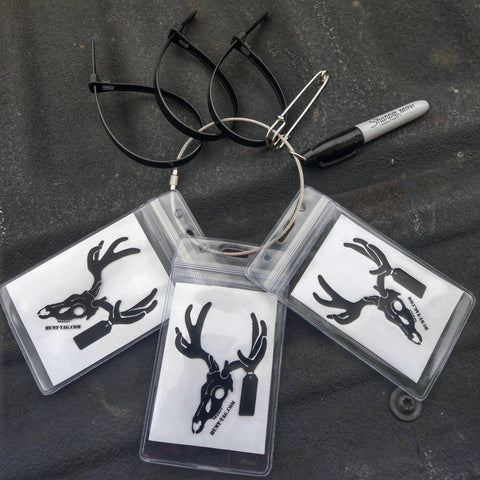
For states using e-tagging systems, keep your phone accessible and know exactly how to navigate to the tagging function. Having a kit like the Hunt-Tag System E-Tag Kit or a general Paper Tag Kit means you have everything you need in one place.
FAQs About Organizing Hunting Documents
What happens if I lose my documents during a multi-day trip?
If you lose your physical documents in the field, you may be able to access digital copies through your state wildlife agency's app or website. Many states allow this, but not all. Check your specific state's regulations before relying on this as a backup.
For critical trips, carry both physical and digital copies and store them in separate locations in your pack.
How do I organize documents when hunting across multiple state lines?
Keep documents separated by state, ideally in different sleeves or compartments. Before crossing into a new state, verify that you're carrying the required documentation for that state.
Some hunters keep a checklist taped inside their document organizer showing what's required for each state on their trip.
This prevents the common mistake of leaving required documents in the truck when you're hunting in a different state than where you started.
What's the minimum I need to carry in the field versus keeping at camp?
At a minimum, carry your hunting license, unfilled tags for any species you might encounter that day, and any unit-specific permits. In most situations, everything else can stay at camp.
That said, "minimum" depends on your state's specific requirements. Some states require additional stamps or authorizations to be on your person. Read your regulations carefully.
Organize Hunting Documents with Hunt-Tag for Stress-Free Inspections
Hunt-Tag builds systems for hunters who want that confidence baked into their routine.
From the Hunt-Tag Wallet that keeps licenses and permits protected and easy to reach, to tag kits and Tech Pouch options that support paper tags, e-tags, and phone backups, everything is designed to keep critical documents in one place and ready at a moment's notice.
A simple, consistent setup removes guesswork in the field. When your hand knows exactly where to go for a license or tag, inspections become quick and uneventful.
Shop now to explore Hunt-Tag document organizers built for multi-day hunts and real field conditions, so the only thing you have to focus on is the hunt itself.